
By Mentoring Cmdt Ambassador Alistair
Nigeria is once again confronted with an uncomfortable but necessary question: how does a nation battling economic hardship reconcile public service with lifestyles that appear far removed from public earnings?
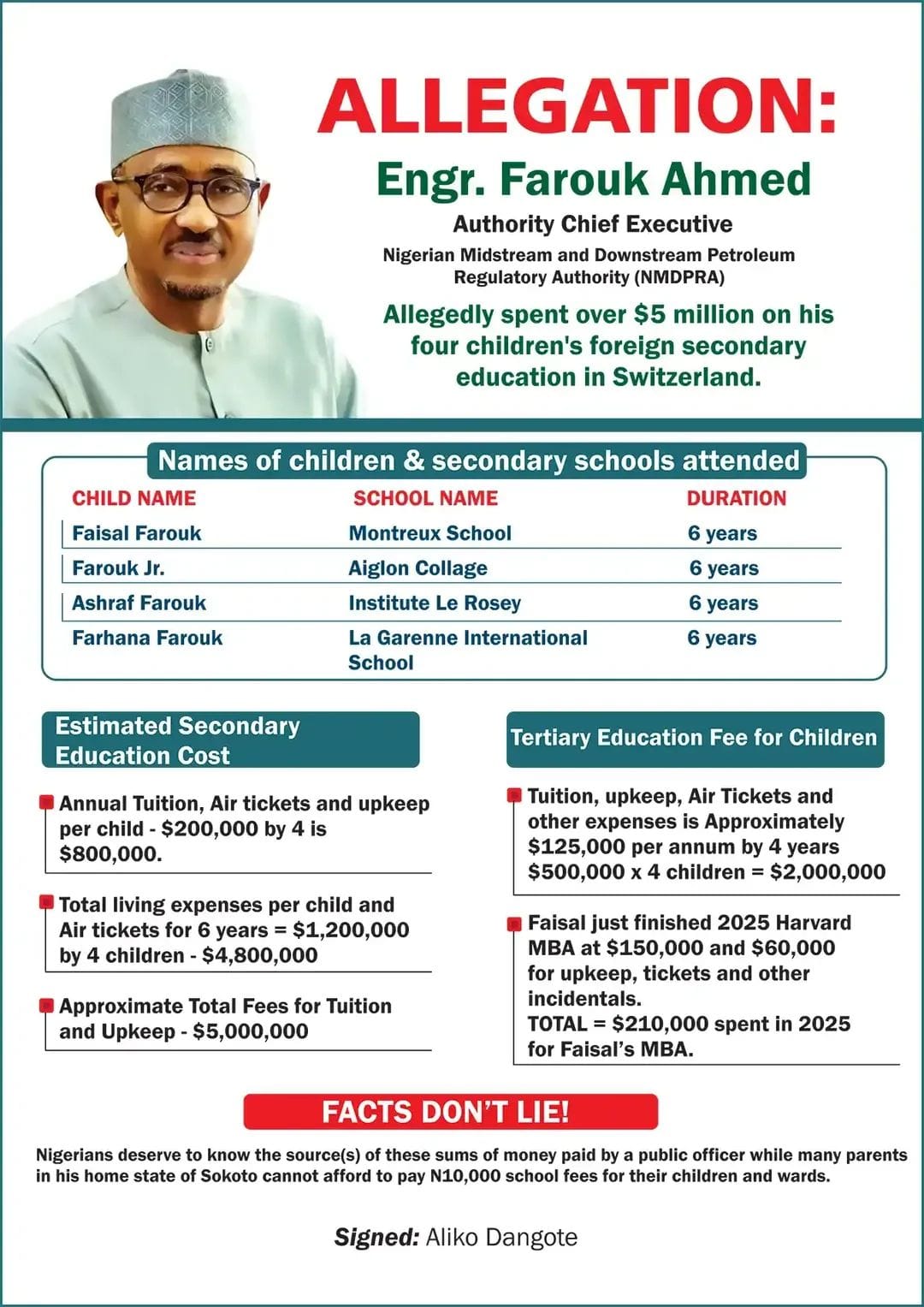
The recent allegation involving Engr. Farouk Ahmed, Chief Executive of the Nigerian Midstream and Downstream Petroleum Regulatory Authority (NMDPRA), has triggered widespread debate after Alhaji Aliko Dangote publicly questioned the source of funds allegedly used to educate four children in Switzerland at a reported cost of about $5 million. The controversy is not merely personal. It goes to the heart of public accountability in a country struggling to restore trust in its institutions.
Independent analysis of fees at elite Swiss boarding schools such as Institut Le Rosey, Aiglon College, La Garenne International School and comparable schools in the Montreux region suggests that tuition and boarding alone for four children over six years would reasonably fall in the $2.7–3 million range.
Switzerland is among the most expensive education destinations in the world, and such figures are not implausible.
The remaining difference between this estimate and the widely cited $5 million could reasonably be attributed to additional costs: premium international travel, accommodation, staffing, security, holidays, and other lifestyle expenses often associated with long-term residence abroad. This distinction is important.
Facts, not exaggeration, must anchor public debate.
Yet even at the lower end of the estimates, the broader question remains unavoidable. How does such expenditure align with the earnings and declared income of a senior public official leading a regulatory agency?
The NMDPRA reportedly generates billions of naira monthly, with regulatory charges estimated at around ₦200 per litre of fuel. Nigerians are therefore entitled to ask what value is being delivered for this revenue, whether regulatory costs are proportionate, and whether financial transparency within such agencies meets the standards expected in a modern democracy.
This is not an argument against private success or parental ambition. It is an argument for proportionality, disclosure and trust. Public office is not a private estate; it is sustained by national resources and public sacrifice.
The significance of this episode is amplified by the source of the allegation. Aliko Dangote is not a casual commentator. As Africa’s most prominent industrialist, and multi billionaire, his business interests are subject to intense scrutiny at home and abroad. When such a figure raises questions about governance, they cannot simply be waved aside. His intervention reflects a wider anxiety within Nigerian society: that oversight has weakened while opacity has grown.
The deeper problem, however, lies in the credibility of investigative mechanisms. Many Nigerians fear that parts of the judiciary and oversight structures have become compromised or politicised, eroding confidence in domestic accountability processes. This perception, whether fully justified or not, is corrosive.
One practical response would be to draw on Nigeria’s extensive diaspora of legal, forensic and compliance experts in the UK, Europe and North America. Short-term secondments or advisory roles, voluntary or paid, could support investigations and institutional reviews. Such professionals operate under strict ethical regimes and have reputations in their host countries to protect. Their involvement would enhance credibility without undermining national sovereignty.
This moment calls for leadership. The government has an opportunity to demonstrate that Nigeria is serious about reform, transparency and the rule of law. Selective outrage will not suffice; what is needed is a clear, consistent standard that applies across public service.
Equally, the National Assembly must exercise restraint. Oversight is constitutional, but premature intervention risks weakening due process. Investigations should be allowed to follow evidence wherever it leads, free from political pressure.
Nigeria is already under intense global scrutiny. Every unresolved controversy damages investor confidence, diplomatic standing and institutional legitimacy. The country cannot afford further erosion of trust.
The debate sparked by Dangote and Farouk should therefore be seen not as a distraction, but as an opportunity, a chance to reset standards, strengthen accountability and reaffirm that public service remains exactly that: service to the public.
Mentoring Cmdt Ambassador Alistair is President, NIDME CORP.


