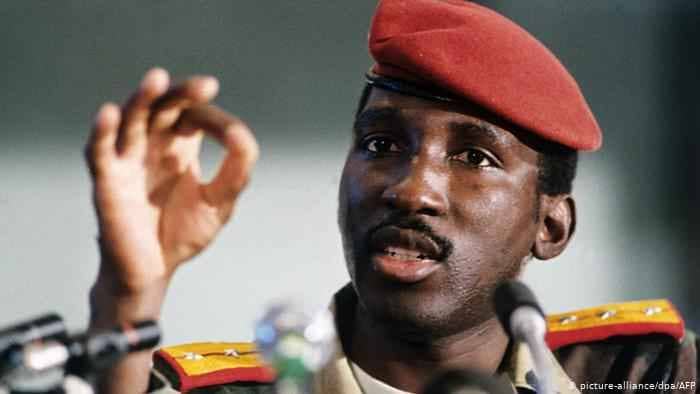
The Transformative Governance Forum (TGF) today, 21st December, 2025, paid solemn tribute to the life, ideals, and transformative legacy of Captain Thomas Isidore Noël Sankara, the revolutionary President of Burkina Faso from 1983 to 1987, whose visionary leadership, revolutionary integrity and principled pan-Africanism earned him the immortal title of “Africa’s Che Guevara”.
TGF in a statement e-signed by Ademola Rabiu CEng, Directorate of Strategic Engagements & Partnerships wrote:
“On the anniversary of his birth, we remember a leader who dared to imagine and build a self-reliant Africa, and whose principles remain a vital compass for our continent’s pursuit of true sovereignty and equitable governance.
Sankara’s brief but intense period of leadership remains a powerful beacon of what is possible when visionary leadership is committed to the dignity and self-reliance of its people. The period was a bold experiment in radical, people-centred transformation.
Sankara ascended to power in Upper Volta, the former French colony, with a clear, audacious vision: to liberate a nation shackled by a colonial legacy, foreign dependency, corruption, and poverty, which he renamed “Burkina Faso, “the “Land of People of Dignity. This was not merely symbolic; it was a declaration of a new social contract based on dignity, austerity, and fierce independence. His leadership, though ended prematurely by assassination, created a blueprint for authentic African development that continues to inspire movements for justice and good governance across the continent.
ROOTS OF A REVOLUTIONARY: FAMILY AND FORMATION
Thomas Sankara’s worldview was shaped from his earliest days. He was born this day, 76 years ago, on *December 21, 1949, in Yako, French Upper Volta (now Burkina Faso), into a middle-class family of mixed ethnic heritage—his father was a Mossi, and his mother was of Fulani (Peul) descent. His father, Joseph Sankara, served as a gendarme (a military policeman) in the French colonial administration, which provided the family with a degree of stability and exposed the young Thomas to the structures of authority. His mother, *Marguerite Kinda*, was a devout Roman Catholic who instilled in him a strong moral compass. This unique family background, which straddled military, colonial employment, and devout faith, gave Sankara an early and complex view of power, service, and identity in a colonised society. He was educated in local missionary schools before embarking on a military career, a path that would become his platform for revolutionary change.
THE UPRIGHT REVOLUTION: SANKARA’S CORE ACHIEVEMENTS
In just four years, President Sankara initiated some of the most profound and rapid social-economic reforms seen in post-colonial Africa:
Women’s Liberation as a Revolutionary Cause: Sankara was arguably Africa’s first feminist head of state. He appointed women to high-ranking government positions, banned female genital mutilation and forced marriages, and promoted contraception. He famously stated, “He who feeds you, controls you,” urging women to achieve economic independence.
Uncompromising Fight Against Corruption:
Declaring that “our revolution will be of value only if… it can answer the concrete problems of the people,” he lived with radical austerity. He slashed government salaries, sold off the fleet of official Mercedes, and made the Renault 5 the official vehicle for ministers. He required public servants to wear locally woven cotton attire and established People’s Revolutionary Tribunals to try former officials for graft.
The Dawning of the Green Revolution: To combat desertification and achieve food sovereignty, Sankara launched a massive nationwide tree-planting campaign. He mobilised the nation to plant over 10 million trees, aiming to break the economic chains of food import dependency.
Mass Mobilisation for Development: He harnessed national pride for public works, mobilising citizens to build infrastructure and leading one of Africa’s most successful vaccination campaigns.
Champion of Health and Education: His government oversaw a monumental public health campaign, vaccinating over 2.5 million children against measles, meningitis, and yellow fever. School enrollment rates doubled as he prioritised literacy and built new schools.
Voice of Pan-African Sovereignty: A fierce critic of neo-colonialism and foreign debt, Sankara argued for a united, self-reliant Africa. In a landmark speech to the then Organisation of African Unity, he boldly rejected structural adjustment and called for a collective front against international financial institutions, declaring, “The debt cannot be repaid… because if we don’t pay, our lenders will not die. But if we pay, we will die.”
A FLAME EXTINGUISHED: ASSASSINATION AND UNANSWERED QUESTIONS
Like his ideological counterpart Che Guevara, Thomas Sankara’s radical challenge to entrenched power structures made him powerful enemies. On October 15, 1987, Thomas Sankara was assassinated in a coup d’état led by his close friend and second-in-command, Blaise Compaoré. Sankara and twelve of his aides were killed and buried in a hastily dug grave. The exact circumstances and foreign involvement have long been shrouded in secrecy.
For over three decades, the quest for truth was suppressed under Compaoré’s regime. However, in a historic turn in 2021, a Burkinabè military tribunal began a long-awaited trial for his murder. In April 2022, Compaoré (in exile), along with thirteen others, was found guilty and sentenced in absentia to life imprisonment for attacking state security and complicity in murder. While the trial provided a measure of judicial closure, many questions about external influences remain, solidifying his status as a martyr for African sovereignty.
His death was a profound loss, but his ideas proved bulletproof. Sankara’s legacy is a powerful, uncompromising example that Africa’s destiny must be forged by Africans, free from external manipulation and internal kleptocracy.
SANKARA’S LEGACY AND THE TGF MISSION
Thomas Sankara’s life and work resonate deeply with the core principles of the Transformative Governance Forum. We will continue to find profound inspiration in his clarity of purpose. Our mission to advocate for transformative, accountable, and people-first governance is an echo of his revolutionary project.
He demonstrated that transformative leadership is defined by: Integrity and Accountability: Advocating for leadership defined by service and sacrifice, Sankara’s personal austerity and war on corruption were not mere policies but a lived ethic, proving that leaders must be the first to sacrifice for the public good.
People-Centered Pragmatism: His successes in health, ecology, and women’s rights show that rapid, tangible improvement in citizens’ lives is the ultimate measure of governance.
Intellectual and Political Sovereignty: His unwavering belief in Africa’s capacity to solve its own problems, free from foreign dictates, is a call for the continent to reclaim its agency—a principle central to our advocacy.
Empowering Marginalised Voices: Centering the most vulnerable in governance, following his commitment to women and youth.
The TGF honours Thomas Sankara not as a flawless icon, but as a revolutionary compass. His vision challenges us to imagine and work toward an Africa where governance is synonymous with integrity, where development is self-determined, and where the dignity of every citizen is the nation’s highest project.
Thomas Sankara was a meteor that blazed across Africa’s political sky. His flame, though violently cut short, continues to light the path for a new generation seeking a truly transformed and incorruptible continent.
“Rest on Comrade Sankara! The torch you light is still burning”.
Ademola Rabiu CEng
Directorate of Strategic Engagements & Partnerships
www.tgf.org.ng
+234 906 145 4984